Key findings
- Only 8 jobs in Nigeria can be confirmed as lost to AI between January 2025 and June 2026 — all at one company, the crypto exchange Zap Africa. Jumia has announced about 200 more cuts, group-wide, without saying how many are in Nigeria.
- The biggest wave of job losses was not caused by AI. Nigerian banks cut staff because of the Central Bank’s recapitalisation deadline and the mergers it forced.
- Nigerians have taken to AI faster than their employers. 88% of adults used an AI chatbot in the past year, yet Nigeria ranks 110th of 147 countries for how deeply businesses have built AI into their operations.
- AI is changing how work is done well before it changes how many people do it — in customer service, insurance, recruitment, content and government.
- New AI jobs are appearing, but the door is narrowing for young workers, as AI takes over the routine tasks that entry-level roles used to be built on.
Summary
AI has changed how Nigerians work long before it has changed how many work.
Most conversation about AI and jobs in Nigeria is about what might happen: millions of routine jobs at risk, whole sectors automated, a generation of graduates locked out. This report looks at what has actually happened between January 2025 and June 2026.
The answer is narrower than the headlines suggest. Across the 18 months, one Nigerian company — Zap Africa — cut jobs and said on the record that AI was the reason: 8 of its 18 staff. Jumia has announced about 200 further cuts tied to AI, group-wide. A much larger wave of job losses hit Nigerian banks in the same period, but it was driven by the Central Bank’s recapitalisation deadline, not by AI.
Meanwhile, AI is already reshaping everyday work. Nigerians use AI tools at one of the highest rates in the world, and companies are using them in customer service, underwriting, recruitment and back-office finance — mostly without cutting headcount yet. The long-range forecasts of millions of jobs lost or created are scenarios, not outcomes.
The gap between how quickly individuals have adopted AI and how slowly employers have built it into their operations is the story of this report — and the factor most likely to shape Nigerian jobs over the rest of the decade.
Finding 01Nigerians have embraced AI; their employers mostly haven’t
Individual use of AI in Nigeria is among the highest in the world. Deep business use is among the lowest.
88% of Nigerian adults used an AI chatbot in the previous 12 months, according to Google and Ipsos’s Our Life with AI survey (2026) — up 18 points in a year, the highest rate of any country surveyed, and well above the 62% global average. An earlier wave of the same research, from January 2025, had already put Nigerian generative-AI use at 70% of the online population, against 48% globally. At work, PwC’s Africa Workforce Hopes & Fears Survey 2025 found 64% of African workers had used AI on the job in the past year, above the 54% global average — though only 17% used AI agents daily.
Businesses tell a different story. Microsoft’s AI Diffusion Report scored Nigeria’s enterprise adoption at 10.1% in Q1 2026, up from 8.7% a year earlier but enough to rank the country only 110th of 147 and 27th in Africa. That score measures how deeply AI is built into infrastructure, skills, spending and use.
Both things are true at once. A Zoho/Arion study found that 93% of Nigerian organisations have started using AI in some form — a free chatbot account, a pilot in one department. Very few have gone further and built it into how the organisation runs. Nigerian organisations have started almost universally and integrated almost nowhere.
Where business adoption is happening, it is concentrated. A Philips Consulting survey of 512 professionals across nine sectors found recruitment and learning-and-development teams furthest ahead, using AI to screen candidates and give staff access to knowledge.
Figure 1Individual chatbot use and enterprise AI adoption
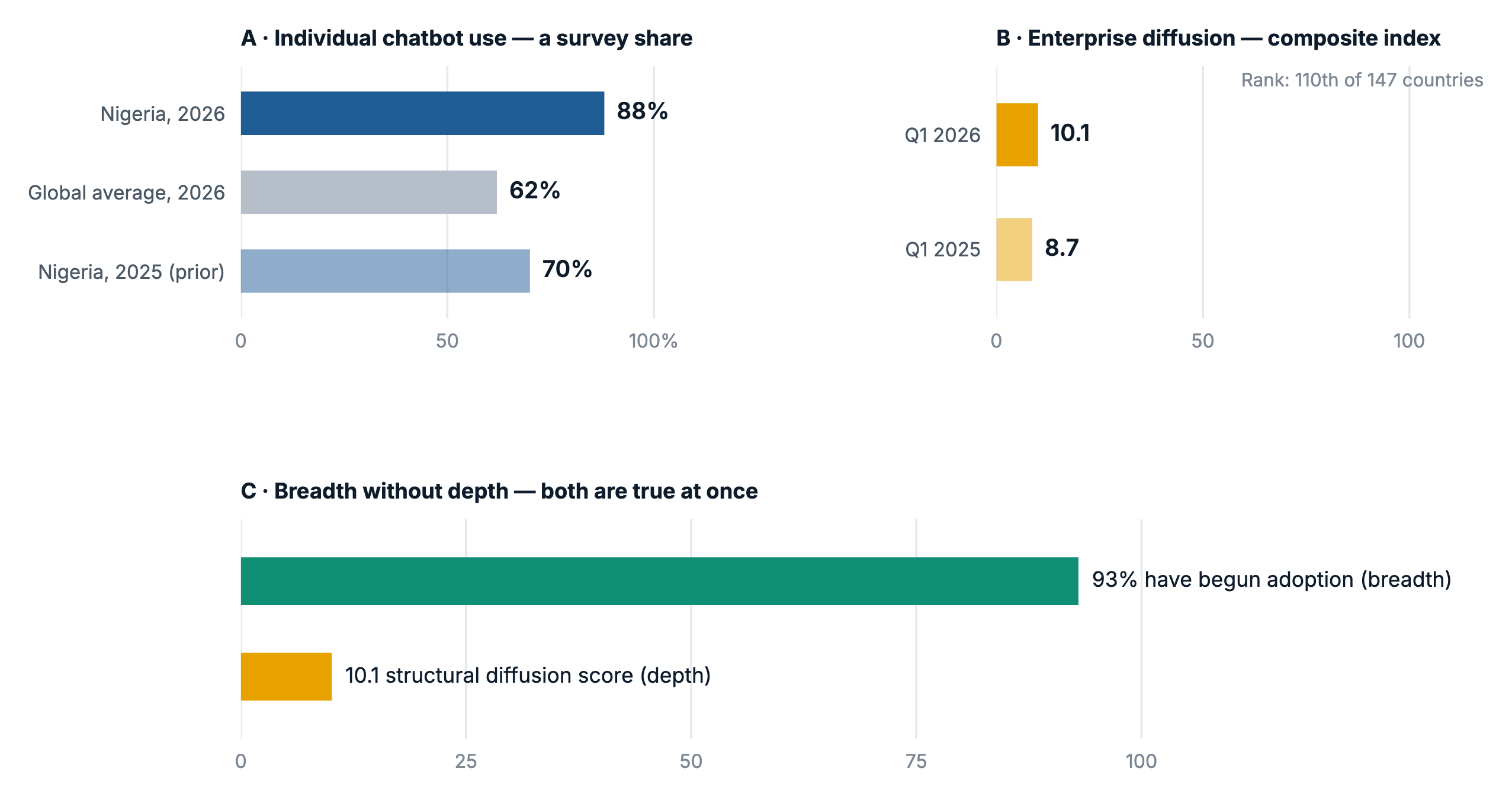
Note. Panel A is the share of adults who report using a chatbot; Panel B is a 0–100 index combining infrastructure, skills, spending and use. The two measure different things and are not directly comparable.
Sources. Google/Ipsos, Our Life with AI, 2026; Microsoft AI Diffusion Report, Q1 2026 and Q1 2025; Zoho/Arion Research, 2025.
The foundations are being built
Nigeria had about 86MW of operational data-centre capacity in 2025, with more than 320MW under construction or planned from Equinix, Microsoft, MTN, Airtel Nigeria, Rack Centre and Kasi Cloud — over $2 billion in committed investment through 2027. Kasi Cloud’s Lekki campus, commissioned in May 2026, is described as the region’s first AI-native hyperscale data centre.
Policy is moving too. Nigeria’s National Artificial Intelligence Strategy, published in September 2025, aims to give 70% of workers aged 16–35 AI-related skills by 2030. Microsoft committed $1 million in February 2025 to AI skills training in Nigeria.
The constraints are real: unreliable power, patchy broadband outside the big cities, public research spending of about 0.2% of GDP against a global average near 2.2%, and an economy in which about 93% of jobs are informal — out of reach of any corporate AI rollout.
Finding 02So far, AI has cost very few confirmed jobs
What has been confirmed is measured in single digits and hundreds. What has been forecast is measured in millions.
Zap Africa: an AI agent replaces a support team
Zap Africa, a Lagos-based crypto exchange, brought in “Martha AI” to handle first-line customer enquiries, then cut its workforce from 18 to 10 — 44% of staff — between December 2025 and February 2026. Its chief technology officer described the move on the record as an “AI-driven efficiency shift”. The AI tool was built by a separate company the CTO also owns, Cognito Systems; the headcount cut itself has been independently reported. Zap Africa is the only Nigerian company in the period to have cut part of its workforce and publicly attributed the cuts to AI.
Jumia: automation as a route to profit
Jumia has deployed AI across logistics, customer support, finance, cybersecurity, seller management, fraud detection and software development, and presents it as its route to profitability by late 2026. Its Q1 2026 report said it was “actively working to further reduce headcount, continue process automation and leverage AI tools”, and announced at least 200 more job cuts — about 10% of its workforce, group-wide, with no Nigerian breakdown, planned for Q2–Q3 2026.
Those announced cuts come on top of a long decline that has already happened. Jumia’s group headcount fell from 4,318 at the end of 2022 to 1,980 in March 2026. Nigeria, its largest market, absorbed more than its share: local headcount fell from 1,119 to 361. Jumia was reporting rising revenue and narrowing losses over the same period — the restructuring is happening alongside financial improvement, not only because of distress.
Figure 2Jumia’s workforce fell by more than half group-wide — and by more than two-thirds in Nigeria
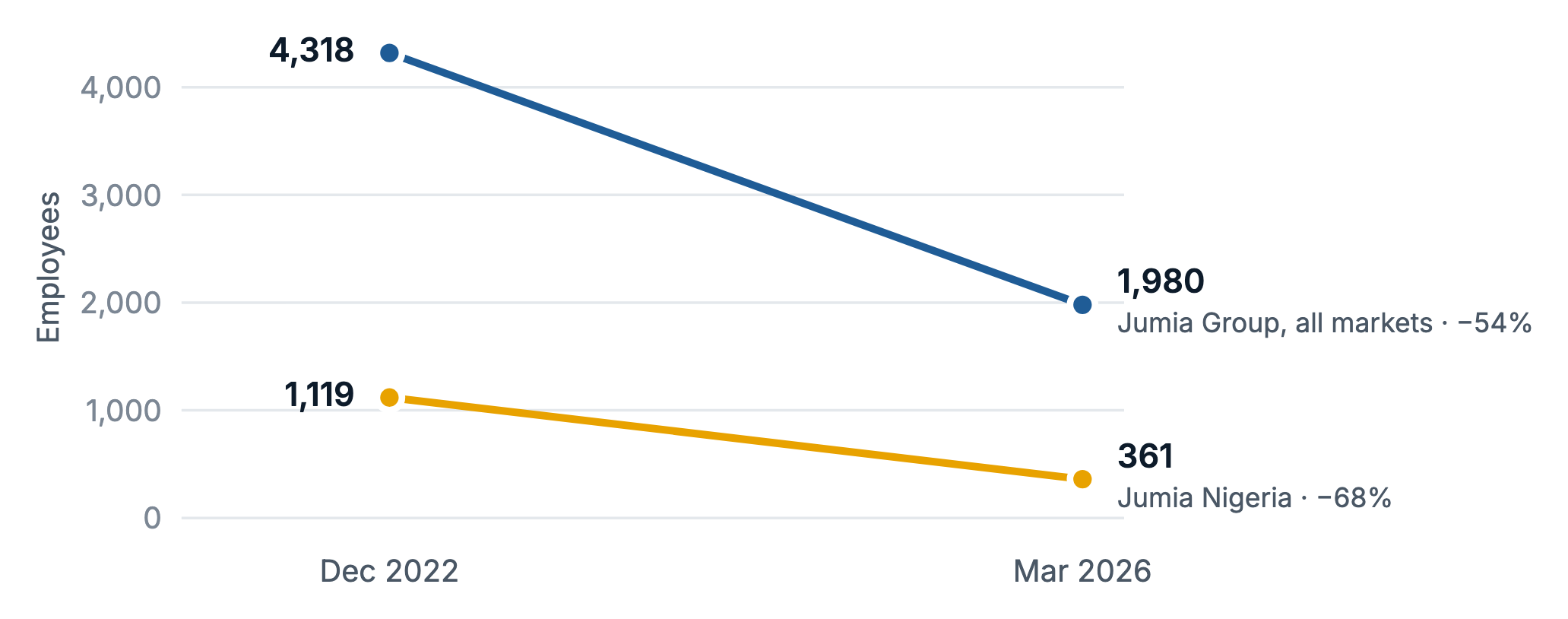
Sources. Jumia Technologies Q1 2026 disclosure; WeeTracker, 14 May 2026; BusinessDay; Techpoint Africa.
aptLearn: a shutdown framed around AI
Nigerian edtech company aptLearn closed its platform in the first half of 2026, saying it was preparing for “an AI-driven strategic reset”. It did not disclose how many jobs were affected.
Every workforce reduction we found
The table lists every workforce reduction at a Nigerian employer we identified in the period, including those where AI was not the stated reason. It is not an exhaustive census.
Table 1Workforce reductions at Nigerian employers, March 2025 – July 2026
| Company | Roles affected | Status | When | Reason given by the company |
|---|---|---|---|---|
| Zap Africa | 8 of 18 (44%) | Completed | Dec 2025 – Feb 2026 | “AI-driven efficiency shift” |
| Jumia (group) | ~200 (about 10%) | Announced | Q2–Q3 2026 | Reduce headcount, automate processes and use AI tools |
| Jumia (Nigeria) | 758 (1,119 → 361) | Completed | Jan 2025 – Jun 2026 | Part of a wider automation programme, not tied to a single event |
| aptLearn | Whole platform | Completed | H1 2026 | Preparing for “an AI-driven strategic reset” |
| Kuda Bank | At least 100 | Completed | Mar 2026 | “Future operational priorities, industry benchmarking, and long-term direction” |
| Unity Bank / Providus | 100 | Completed | Q1 2026 | Merger and recapitalisation |
| First Bank of Nigeria | Hundreds (reported) | Completed | ~Mar 2026 | Restructuring; not confirmed by the bank |
| Quidax | Several teams | Completed | H1 2026 | Shift to business-to-business infrastructure |
Sources. Company statements; TechCabal; TechCabal Insights, State of Tech in Africa H1 2026; BusinessDay; Nairametrics; Techpoint Africa; Technext24; WeeTracker; Innovation Village.
What’s confirmed versus what’s forecast
Forecasts of AI’s effect on Nigerian jobs run to millions — thousands of times larger than anything that has happened so far. They belong in the conversation, but they describe possible futures, not the past 18 months.
Table 2Confirmed, all-cause and forecast figures
| Measure | Figure |
|---|---|
| Jobs confirmed lost to AI in Nigeria (Zap Africa) | 8 |
| Further cuts announced by Jumia, group-wide | ~200 |
| African tech-sector layoffs in H1 2026, all causes | 2,574 |
| Routine Nigerian jobs at risk from automation by 2030 (forecast) | ~9 million |
| New technology-enabled jobs by 2030, if skills investment follows (forecast) | ~11 million |
| Jobs affected if agriculture were fully automated (scenario) | 20 million+ |
Figure 3Confirmed job losses, all-cause layoffs and forecasts, on one scale
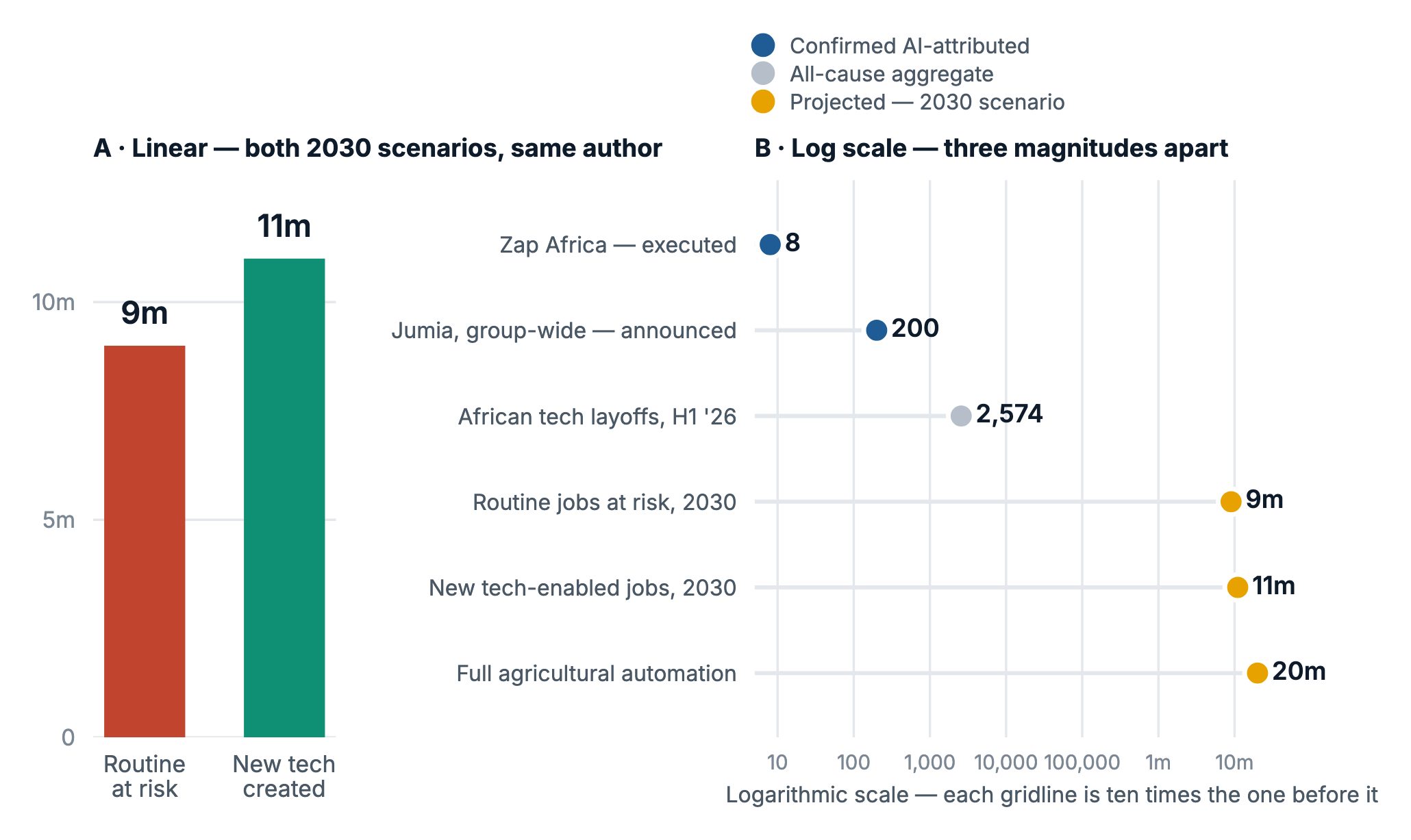
Note. Panel B uses a logarithmic scale: each gridline is ten times the one before it.
Sources. TechCabal, February 2026; TechCabal Insights via BusinessDay, July 2026; The Sun Nigeria, 17 August 2026.
The wider African picture
African tech companies cut 2,574 jobs in the first half of 2026, up from 765 a year earlier and 1,196 in H1 2023, according to TechCabal Insights. It attributes the rise to a mix of AI adoption, Nigerian bank mergers and general cost-cutting; AI accounts for a small part of the total. The same period saw 13 tech-company shutdowns across Africa. In Kenya, Standard Chartered has reduced its local workforce to below 1,000 through automation and a shift to digital banking.
Finding 03The biggest layoffs weren’t caused by AI
Nigeria’s largest job losses came from banking — and the cause was a regulatory deadline, not technology.
The Central Bank of Nigeria gave banks until 31 March 2026 to meet new minimum capital requirements. The deadline forced a wave of mergers and cuts:
- Kuda Bank cut at least 100 roles in a reorganisation of its marketing departments in March 2026, citing “future operational priorities, industry benchmarking, and long-term direction”.
- Unity Bank’s merger with Providus Bank cost 100 jobs.
- First Bank reportedly let go of hundreds of long-serving contract staff, following the removal of about 100 senior executives in 2024.
Many of the same banks were expanding AI chatbots and back-office automation at the same time, and TechCabal’s reporting notes that AI is being used to shrink customer-support, marketing and operations teams. But none of these banks named AI as the reason for their cuts, and the timing matches the recapitalisation deadline and merger integration.
Other cuts in the period had other causes too. Flutterwave cut about half of its Kenyan and South African staff in 2025 as it prepared for a possible stock-market listing; Nigerian operations were largely unaffected. Crypto exchange Quidax cut several teams as it shifted towards business customers. Neither cited AI.
Finding 04AI is changing how work gets done, not how many do it
Evidence of AI changing daily work in Nigerian organisations is far more widespread than evidence of it cutting jobs.
This follows the global pattern at this stage of adoption: the work changes first, and the organisation chart follows later, if at all.
Table 3Where AI is changing work in Nigeria
| Area | How AI is being used | Effect on jobs so far |
|---|---|---|
| Customer service | Chatbots at 13+ deposit money banks; Martha AI at Zap Africa; support automation at Jumia | Slower hiring reported; confirmed cuts only at Zap Africa and Jumia |
| Data entry and records | Document scanning and registry digitisation in the public sector; automated reconciliation | Highly exposed; no confirmed cuts |
| Insurance underwriting and claims | AI-assisted risk assessment, pricing and fraud checks (e.g. Leadway Assurance) | Roles changing; headcount stable |
| Recruitment and training | Candidate screening and shortlisting; learning content | Most advanced adopters; no confirmed cuts |
| Accounting and finance | Automated reconciliation, invoicing and compliance checks | Jumia’s admin costs fell 7% in one quarter |
| Marketing and content | AI built into copywriting and content roles | Job postings now ask for AI skills |
| Software development | AI-assisted coding at Jumia and fintechs | Fewer junior placements reported by recruiters |
| Public administration | “Service-Wise GPT” helps civil servants find regulations | Early stage |
Sources. Company disclosures; Philips Consulting, 2026; Nigerian public-sector reporting and trade press, 2025–2026.
Of 11 role categories where AI is in use in Nigeria, only two — Jumia’s operations and logistics roles, and Zap Africa’s customer support — have seen job cuts that the company has confirmed.
Figure 4From AI in use to confirmed job cuts
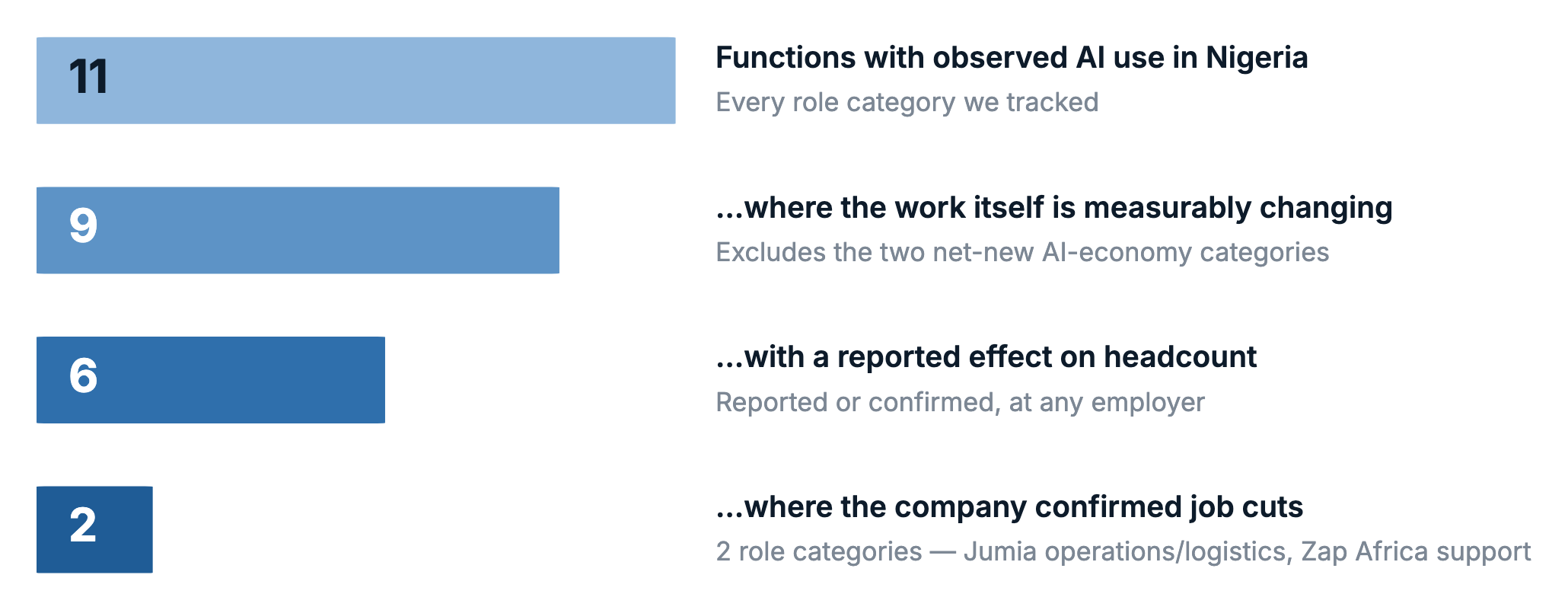
Source. TechBlit Insight analysis of 11 role categories where AI is in use in Nigeria.
Insurance: a talent problem, not a layoff story
Nigerian insurers increasingly use AI for underwriting, pricing, claims and fraud detection — Leadway Assurance uses it to flag suspicious claims before payout. Deloitte’s 2026 Global Insurance Outlook finds experienced underwriters and actuaries retiring while newly hired, AI-literate graduates are often placed in conventional roles. The problem is using new talent well, not a net loss of jobs.
Productivity: early and hard to measure
There is little hard data yet on AI’s effect on Nigerian productivity. The clearest figure is Jumia’s 7% cut in general and administrative costs in Q3 2025, which it linked partly to AI — a single quarter, company-reported. Currency swings and non-AI restructuring move the same numbers. For international context, PwC’s 2025 Global AI Jobs Barometer found revenue per employee grew three times faster in the industries most exposed to AI (27% against 9%), and that AI-skilled workers earn a 56% wage premium.
Finding 05New AI jobs are appearing — and they’re more accessible
The new roles need less formal computer-science training than the last wave of tech jobs.
Table 4Emerging AI-related roles in Nigeria
| Role | Entry level | Notes |
|---|---|---|
| Data analyst | Entry-level, widely available | Common starting point; ₦300,000–700,000 a month in Lagos (about $220–520) |
| Data annotator / AI trainer | Entry-level; moderate digital skills | Repetitive work, but in high and growing demand |
| Prompt engineer | Entry to mid level | Growing in customer service and content |
| Machine learning / AI engineer | Mid to senior | Among LinkedIn’s fastest-growing Nigerian job titles |
| MLOps engineer | Senior | Highest local salary ceiling reported |
| AI ethics and governance specialist | Emerging, small numbers | Driven by data-protection rules; 94% of surveyed organisations have a dedicated privacy officer |
Sources. LinkedIn Nigeria job-title data; Nigerian salary surveys, 2026; Zoho/Arion Research, 2025. Naira converted at ₦1,350/$ (September 2026).
Remote work for international employers is the biggest financial opportunity for Nigerian AI professionals, though it comes with costs — backup power, a second internet line — that workers elsewhere don’t carry.
Finding 06Young workers face fewer ways in
The immediate risk for young Nigerians is not being fired. It is fewer doors opening.
The most immediate risk to young workers is what this report calls “quiet displacement”: AI takes over routine tasks first, headcount decisions follow later or not at all, and graduates find fewer entry-level jobs even where existing staff keep theirs.
Official figures make this hard to see. Youth unemployment (ages 15–24) stood at 6.5% in the NBS Q2 2024 Labour Force Survey — low by older standards because a 2023 change narrowed the definition of unemployment, not because conditions improved sharply. The share of young people not in employment, education or training was 12.5%.
Nigeria’s plan to become an outsourcing hub faces a double squeeze. The 3 Million Technical Talent (3MTT) programme aims to train three million digital workers by 2027, but AI is reducing global demand for entry-level coding and support work, while laid-off workers from global tech hubs compete for the same remote jobs. On the positive side, 93% of Nigerian employers surveyed for the WEF Future of Jobs Report 2025 said they plan to reskill staff to work alongside AI — an intention, not yet a funded programme.
The informal economy
About 93% of Nigerian jobs are informal, outside the companies where AI is being rolled out. There is no reliable data on how AI is affecting this work. What evidence exists suggests it reaches informal workers mainly as a personal tool — the 88% chatbot figure includes traders and artisans using AI for business ideas and skills — rather than as a force reorganising their work.
What it means
The evidence supports concern, planning and close monitoring — not the conclusion that AI has already caused mass job losses in Nigeria.
For workers
- Treat AI skills as basic, whatever your job. They are increasingly required even in roles that aren’t being cut, and they carry a wage premium.
- If you’re early in your career, plan for fewer entry-level openings. Build skills AI doesn’t replace easily: judgement, oversight and client work.
- Look at the new entry points — data annotation, prompt engineering, AI training — which need less formal computer-science background, but don’t rely on a single client or contract.
- Use government-backed programmes such as 3MTT and NITDA training, while recognising they are small relative to the youth workforce.
For businesses
- Be clear about why you cut jobs. Blaming AI for cuts made for other reasons invites regulatory and reputational trouble, and makes genuine AI transformation harder to believe.
- Where AI does replace roles, retrain and redeploy rather than treating it purely as a cost cut.
- Give AI-literate graduates real AI work, not conventional roles, or expect early turnover.
- Plan around power and infrastructure, not Silicon Valley timelines.
For government
- Measure it. Add a recurring module to the NBS labour force survey tracking job losses attributed to AI, task automation and reskilling. No such national data exists today.
- Judge skills programmes by jobs, not enrolment. Pair the National AI Strategy’s training targets with employer demand data.
- Study the informal economy, where most Nigerians work and where there is no data on AI’s effects.
- Coordinate power and digital policy. Unreliable electricity limits both AI adoption and data-centre investment.
- Enforce data protection under the Nigeria Data Protection Act 2023 as AI spreads through banking, fintech and insurance.
What to watch next
- Jumia’s announced cuts: whether the ~200 go ahead, and how many are in Nigeria.
- Business adoption: whether Nigeria’s enterprise AI score rises meaningfully from 10.1% — the first sign that individual enthusiasm is turning into organisational change.
- Banking after the mergers: whether banks that have finished recapitalising start naming AI in future restructuring.
- Entry-level hiring: graduate job postings and 3MTT placement outcomes, the earliest signal of quiet displacement.
How we did this
This report covers January 2025 to June 2026, using sources available up to August 2026. We reviewed around 70 sources and cite those listed below, prioritising, in order: Nigerian government and regulators (NBS, CBN, NITDA, NDPC, NCC); company disclosures and on-record statements; Nigerian Exchange filings; academic and think-tank research; international institutions where they publish Nigeria-specific data; and established Nigerian and pan-African business media. Unverified social media posts were excluded.
A job loss is counted as caused by AI only when the employer has said so on the record. Figures a company reports only for several countries combined are reported as group figures, not counted as Nigerian.
Limitations. Nigerian companies rarely publish why staff leave, so company-level evidence relies on statements, credible reporting and executive interviews. There is no national count of job losses caused by AI, no reliable productivity data, and no data on the informal economy. Because AI adoption and layoff coverage both cluster around a handful of tech and fintech firms, this report should not be read as representative of Nigeria’s labour force of about 89 million people.
Disclosure. TechBlit is a commercial media business; some companies named in this report may be advertisers, partners or event sponsors. This report received no external funding. It is for information only and is not investment, legal, employment or policy advice.
Report code TBI-2026-Q3. Research by the TechBlit Insight desk, led by Vure.
Sources
Government, regulators and policy
- National Bureau of Statistics (NBS) — Nigeria Labour Force Survey, Q2 2024 – Q2 2025. nigerianstat.gov.ng. Accessed 12 Sep 2026.
- NBS, via BusinessDay — “10 key takeaways from Nigeria’s 2024 labour force survey”. businessday.ng. Accessed 18 Sep 2026.
- National Information Technology Development Agency (NITDA) — National Artificial Intelligence Strategy, September 2025. Accessed 5 Sep 2026.
- OECD.AI Policy Navigator — National AI Strategy entry, Nigeria. oecd.ai. Accessed 5 Sep 2026.
- Central Bank of Nigeria / Vanguard — naira–dollar reference rates, 9 September 2026. vanguardngr.com. Accessed 18 Sep 2026.
- 3 Million Technical Talent (3MTT) programme — Federal Ministry of Communications, Innovation and Digital Economy. 3mtt.nitda.gov.ng. Accessed 27 Aug 2026.
Companies
- Jumia Technologies — Q1 2026 results and CEO Francis Dufay’s Bloomberg TV interview, via WeeTracker, “Jumia AI Job Cuts, Profitability 2026”, 14 May 2026. Accessed 20 Aug 2026.
- Zap Africa — statement by CTO Moore Dagogo-Hart to TechCabal, “Zap Africa cuts 44% of workforce in AI-driven restructuring”, 28 February 2026. Accessed 20 Aug 2026.
- Leadway Assurance — public statements on AI-enabled claims screening, 2026. Accessed 25 Aug 2026.
Nigerian and pan-African media
- BusinessDay — “African tech layoffs hit record high as AI, banking mergers eliminate 2,500 jobs in H1 2026”, 21 July 2026. Accessed 24 Aug 2026.
- TechCabal — “5 Nigerian companies that have cut staff in Q1 2026”, 27 March 2026. Accessed 20 Aug 2026.
- TechCabal Insights — State of Tech in Africa H1 2026. Accessed 18 Sep 2026.
- TechCabal Insights — “Inside Africa’s tech layoffs: What the data says (2023–2026)”, 29 June 2026. Accessed 24 Aug 2026.
- Techpoint Africa — “Techpoint Digest” on Jumia’s 200 job cuts, 15 May 2026. Accessed 20 Aug 2026.
- Technext24 — “AI layoffs: 10 companies that cut jobs in H1 2026 and why”, 24 July 2026. Accessed 24 Aug 2026.
- Nairametrics — Nigerian startup layoffs coverage, 2026. Accessed 22 Aug 2026.
- Innovation Village — Nigerian tech layoffs and shutdowns coverage, 2026. Accessed 26 Aug 2026.
- Guardian Nigeria — public-sector AI adoption and youth labour-market coverage, 2026. Accessed 26 Aug 2026.
- The Sun Nigeria — “AI disruption: 9m Nigerian jobs may disappear by 2030 – Experts”, 17 August 2026. Accessed 20 Aug 2026.
- Rest of World — “AI and immigration uncertainty threaten Nigeria’s dreams of becoming an outsourcing hot spot”, July 2025. restofworld.org. Accessed 15 Aug 2026.
Research and international institutions
- Google / Ipsos — Our Life with AI, 2026, and the January 2025 wave. Accessed 18 Sep 2026.
- Microsoft — AI Diffusion Report, Q1 2026 and Q1 2025. microsoft.com. Accessed 18 Sep 2026.
- Zoho / Arion Research — The AI Privacy Equation: The Nigerian Model of Responsible AI Adoption, 8 September 2025. Accessed 5 Sep 2026.
- ITWeb Africa — “Zoho says Nigeria offers global model for responsible AI adoption”, 9 September 2025. Accessed 5 Sep 2026.
- PwC — 2025 Global AI Jobs Barometer. pwc.com. Accessed 15 Aug 2026.
- PwC — Africa Workforce Hopes and Fears Survey 2025. pwc.com. Accessed 15 Aug 2026.
- World Economic Forum — Future of Jobs Report 2025, 8 January 2025. weforum.org. Accessed 15 Aug 2026.
- Philips Consulting — Nigeria talent management and AI adoption report, February 2026. Accessed 22 Aug 2026.
- Deloitte — 2026 Global Insurance Outlook, via businessamlive.com. Accessed 26 Aug 2026.
- Bloomberg — Nigeria AI data-centre investment reporting, October 2025. Accessed 20 Aug 2026.
- LinkedIn Nigeria — job-title growth data, 2026. Accessed 27 Aug 2026.
- UNESCO — Nigerian public-sector AI training coverage (Service-Wise GPT), 2026. Accessed 27 Aug 2026.